
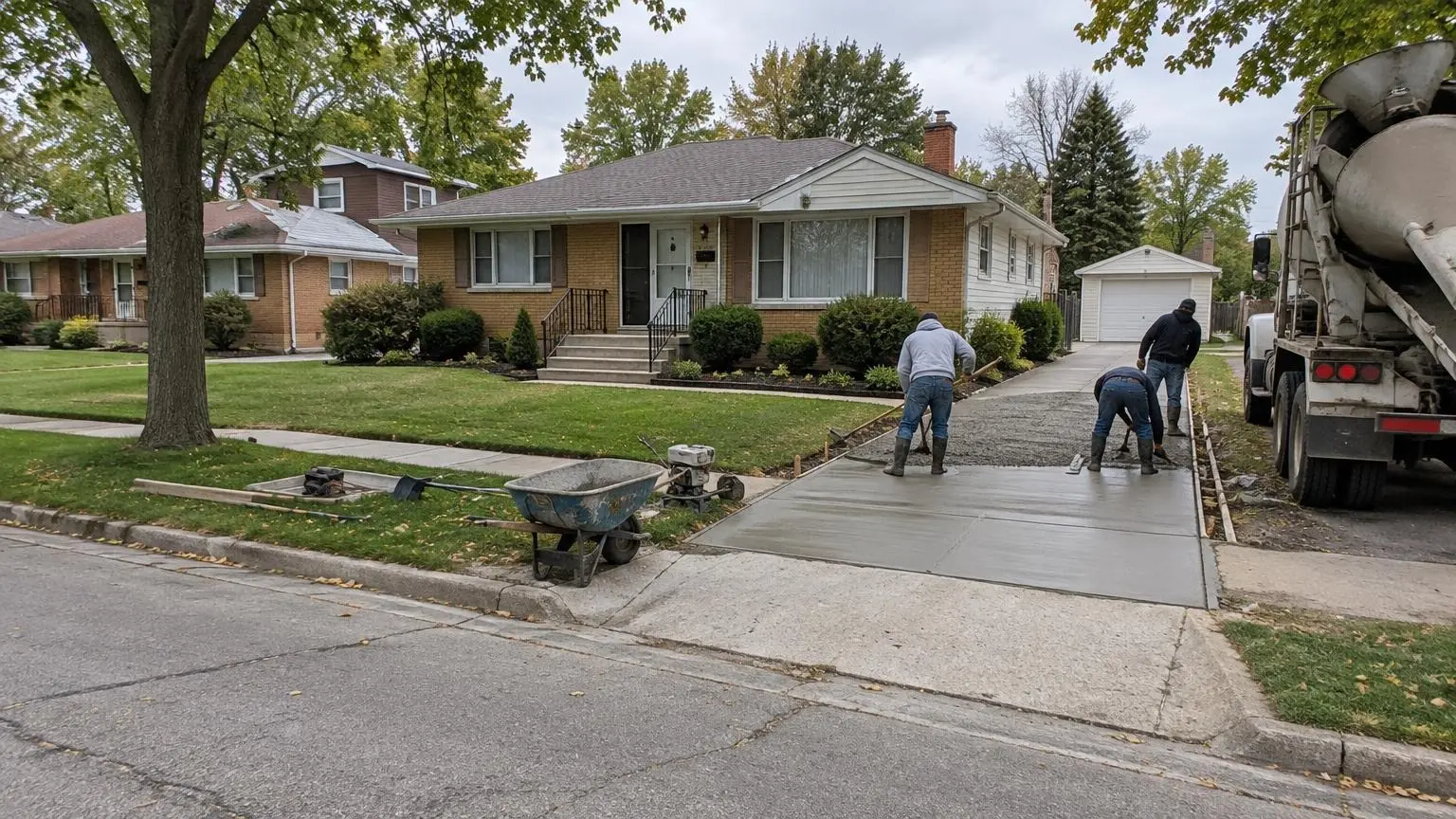
Replacement, widening & approaches
Concrete Driveways in Taylor, MI
A new driveway with a real base under it, pitched to drain and sized for the cars you own now.
- Free measuring visit at the property
- Itemized written quote for every job
- Permit status checked with Taylor's Building Department before scheduling
Replacing a Driveway That Has Done Its Time
Concrete driveways in Taylor are, on many streets, as old as the houses. With a median build year of 1963 for local housing, per Point2Homes' summary of Census data, plenty of original drives have carried cars through more than half a century of Michigan winters. They tend to fail in a familiar order: the surface near the street starts to flake from salty slush, cracks open across the middle, and the last panel before the garage sinks until water stands at the door.
Signs a driveway needs replacing
- Flaking or pitting across much of the surface
- Cracks wide enough to catch a coin, or with one side higher than the other
- A sunken panel at the garage that holds water or ice
- Water running toward the house or garage instead of the street
- Broken edges along the lawn and a crumbling approach at the curb
- A single lane that forces cars to shuffle every morning
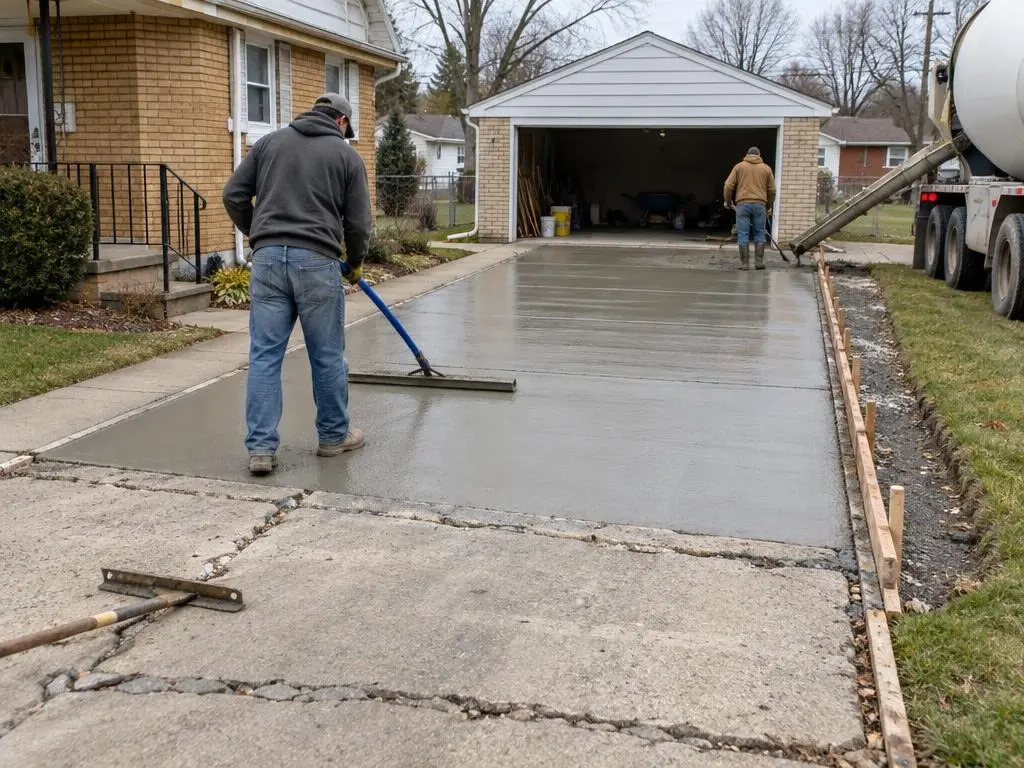
One dropped panel in an otherwise sound driveway can often be lifted or replaced on its own. When settling, wide cracks and scaling show up together, replacing the drive usually costs less over the next twenty years than patching it every spring.
Why the base matters more on clay
Taylor sits on low, flat ground. Wikipedia's article on the Ecorse River, whose South Branch flows through the city, notes that clay soil and heavy development limit how much water the ground absorbs. Under a driveway, that water stays put, freezes and heaves the slab, then softens the clay so it settles in spring. Our process starts below the surface: break out the old drive, dig out soft or organic soil, and compact crushed stone in layers so the slab has firm support and water has somewhere to go. Forms are set so the finished surface falls toward the street, away from the garage floor and foundation.
Thickness, steel and joints
HomeGuide's driveway guide calls for at least 4 inches of concrete for ordinary cars, 5 to 6 inches for RVs or heavy traffic, and thickened edges of 6 to 8 inches. If a work truck, trailer or camper parks on the drive, we thicken that area. The mix is air-entrained for freeze-thaw resistance. Rebar or wire set in the middle of the slab holds cracked pieces together, and joints on a planned grid control where shrinkage cracks run.
Widening a single-lane drive
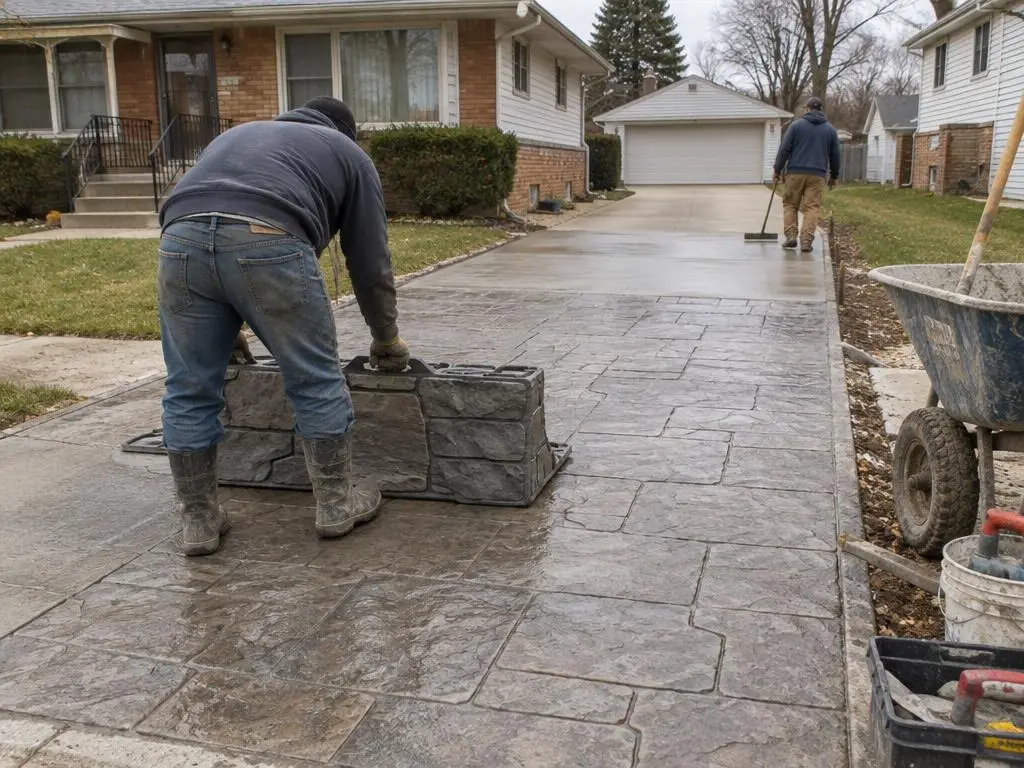
Many 1950s and 1960s lots were laid out with a narrow drive running beside the house. Widening it, adding a side parking pad, or flaring the entry at the street are common requests. The new concrete is doweled into existing slabs where they stay, and the whole layout is pitched as one surface so water does not collect where old meets new. Taylor's tree planting rules keep easement trees at least ten feet from driveways, which is worth knowing if you are planning a wider approach near an existing street tree.
Permits and the approach
The City of Taylor's permits page lists both "concrete or asphalt work" and "driveway/approach" among jobs that need a permit, and the Building Department asks for a copy of the construction contract with the application. The city's zoning review fee is waived when existing concrete is removed and replaced. We handle the permit and schedule inspections as the city requires.
Caring for a new driveway
Stay off it with cars for at least seven days, and keep heavy vehicles off for about 30. Use sand, not salt, the first winter, and avoid de-icers made with ammonium nitrate or ammonium sulfate after that. HomeGuide recommends the first sealer coat after 28 to 30 days and resealing every 2 to 3 years. Point downspouts away from the slab and ask whoever plows to keep the blade a little high.
What the Driveway Price Includes
Each of these appears as its own line on your written quote.
Removal and hauling
Old concrete, asphalt or gravel broken out and taken away, along with soft soil beneath it.
Stone base
Crushed stone placed and compacted in lifts so the slab is supported and water drains.
Grade and forms
Forms set so the surface falls toward the street and away from the garage.
Reinforcement
Rebar or welded wire placed mid-slab, sized to the driveway and what parks on it.
Pour and finish
Air-entrained concrete placed, broom finished and jointed on a planned layout.
Widening and pads
Extra lanes, side pads and flared entries doweled into the existing drive.
Typical Concrete Driveway Costs
| Item | Published range |
|---|---|
| Standard driveway, per sq ft installed | $6 to $10 |
| One-car, 10 x 20 ft | $1,200 to $3,000 |
| One-car, 12 x 24 ft | $1,700 to $4,300 |
| Two-car, 20 x 20 ft | $2,400 to $6,000 |
| Old driveway removal, per sq ft | $2 to $6 |
| Grading, per sq ft | $3 to $8 |
| Sealing, per sq ft | $1 to $3 |
Figures from HomeGuide's concrete driveway cost guide (national averages, standard to basic quality). Taylor pricing can run higher or lower. The written estimate after measuring is your price.
Start to Finish
1. Measure and quote
We measure, check drainage and the approach, and give you an itemized written price.
2. Permit
We confirm and file what the city requires for your driveway.
3. Tear-out and base
Old drive removed, soft clay dug out, stone compacted to grade.
4. Pour and cure
Concrete placed and finished, then written dates for driving and sealing.
Why Choose Us for Concrete Driveways
Built for the vehicles you have
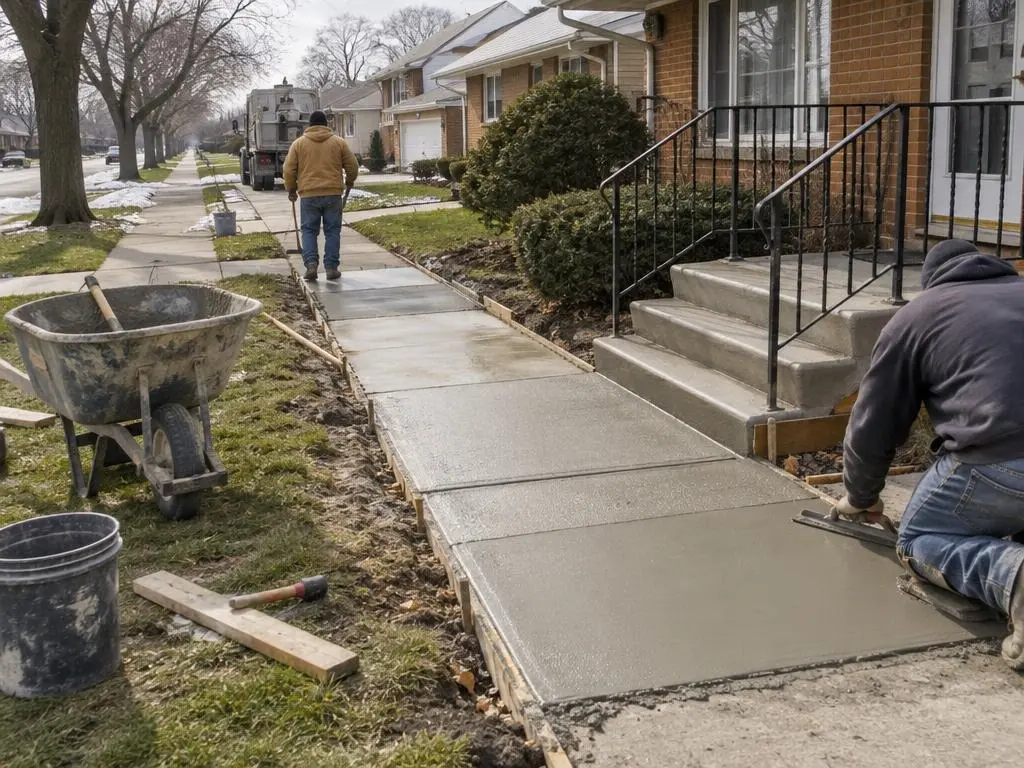
Thicker sections where trucks, trailers or campers park.
Drainage planned
Pitch set so water leaves the garage door and the house.
Concrete Driveways Questions
How long does a concrete driveway last?
HomeGuide's cost table lists 30 to 40 years for a well-built, maintained concrete driveway. On Taylor's clay soils, the base, drainage and regular sealing decide where in that range a driveway ends up.
How thick should my driveway be?
HomeGuide recommends at least 4 inches for cars and 5 to 6 inches for RVs or heavy use, with thicker edges. We add depth at the approach and wherever a heavier vehicle parks.
Can you pour over my old driveway?
We rarely recommend it. New concrete over a cracked, sunken slab inherits its problems and raises the surface at the garage and the street. Removing the old drive and rebuilding the base is the reliable route.
Does Taylor require a permit to replace a driveway?
The city's permits page lists driveway and approach work and concrete work among jobs that need a permit. The zoning review fee is waived when existing concrete is removed and replaced. We take care of the permit.
Can I widen my single-lane driveway?
Usually, yes. We dowel the new section into the existing slab or replace the whole drive, depending on its condition, and confirm the layout with the city as part of the permit.
Concrete Driveways Service Areas
- Concrete Contractors in Taylor, MI
- Concrete Contractors in Dearborn, MI
- Concrete Contractors in Dearborn Heights, MI
- Concrete Contractors in Westland, MI
- Concrete Contractors in Southgate, MI
- Concrete Contractors in Allen Park, MI
- Concrete Contractors in Lincoln Park, MI
- Concrete Contractors in Wyandotte, MI
- Concrete Contractors in Romulus, MI
- Concrete Contractors in Riverview, MI
- Concrete Contractors in Trenton, MI
- Concrete Contractors in Woodhaven, MI
- Concrete Contractors in Brownstown, MI
- Concrete Contractors in Wayne, MI
- Concrete Contractors in Inkster, MI
- Concrete Contractors in Garden City, MI
- Concrete Contractors in Melvindale, MI
- Concrete Contractors in Flat Rock, MI
- Concrete Contractors in Canton, MI
- Concrete Contractors in Van Buren Township, MI
- Concrete Contractors in Belleville, MI
- Concrete Contractors in Grosse Ile, MI
- Concrete Contractors in Ecorse, MI
- Concrete Contractors in River Rouge, MI
- Concrete Contractors in Livonia, MI
- Concrete Contractors in Huron Township, MI
Get a Concrete Driveways Estimate
We measure your driveway and price it in writing, in Taylor and nearby Downriver cities.